

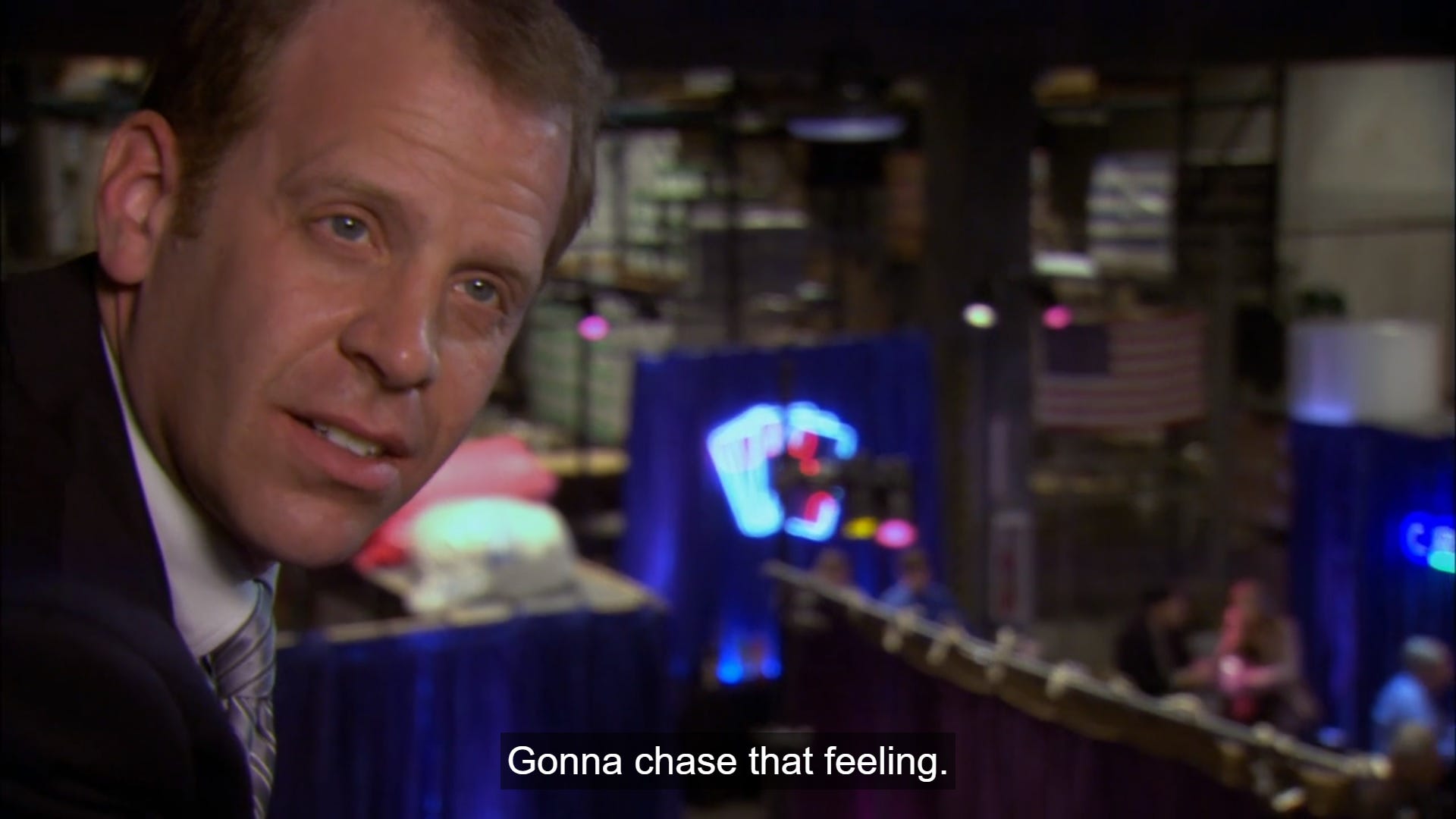
Over the weekend I attended a poker game with some friends.
I say “friends” — truth is, it was a group I’d never played with before.
But what surprised me was how quickly the personalities at the table revealed themselves. Within the first few hands, you could spot who was who.
As in every poker game I’ve ever played, the first to show their hand were the fish.
For those unfamiliar with the term, “the fish” are the players who can’t resist every deal. They play almost every hand — the poker equivalent of YOLO day traders. Sure, they’ll win a few, but most end in disaster. And as always, they’re the first to buy back in when the chips run dry (something that happened twice in the first two hours).
Next up: the bluffer — the guy who occasionally folds but loves to go big when he sniffs weakness. He doesn’t play the hand — he plays the people.
Then there’s the gambler — similar to the fish, but more erratic. He’ll sit out a few rounds, get bored, and suddenly shove a stack on a trash hand. Occasionally it works, but mostly it doesn’t.
And lastly, there’s me.
Some might say “boring and conservative,” others “patient and risk-aware.” Either way, my poker strategy mirrors my trading one:
Add with size when the odds are stacked in your favor, and sit back when they’re not.
Simple in theory. Hard in practice.
Sitting there folding hand after hand, winning just a few pots across the night, demanded patience — the same patience that every successful trader cites as their edge. And it’s something I’m constantly working on.
Did I play a perfect game? Absolutely not. More than once, I folded a hand that would’ve won big if I’d just held on.
But that’s the game — in poker and in trading. Sometimes you have to watch others scoop the pot while you protect your stack for the real opportunity.
And right now, I think we’re holding one.
Playing the Cards, Not the Table
Over the last month or so, I’ve sat back and allowed the market to come to me - citing breadth concerns, divergences and - most importantly - price, to justify my conservative approach.
But that’s the game - most of the times markets are boring, with price action chopping up one day and down the next. Bases take time to build and retracements, which most see as a one or two week event, can take months to conclude.
During these times you’ll typically see ‘the fish’ make a trade on almost every potential setup. Whether the signal comes in the form of an RSI divergence or a VWAP ‘kiss’, they’re the first to scale in with size and often the last to claim profit.
You don’t have to look far to see this kind of behavior.
Just search ‘BMNR’ on X and you’ll see a host of well known traders that have spent the best part of a month underwater on their positions, all because they couldn’t resist the urge to scale in before the move.

And then comes ‘the bluffer’.
These are the guys who scale in a few weeks after ‘the fish’, citing that ‘the low is officially in’ in a bullish, cocksure way. They’re so certain of their position that even when price moves against them, they’ll stay locked in to the sum of a 50% drawdown before closing out their position and deleting any tweet referencing the trade.
At that moment, the true players smell blood in the water. Secure in the knowledge that their opponents have been stopped out - paralyzed by fear when the winning trade actually presents itself.
Here’s this exact scenario playing out on Coinbase over the last few weeks:
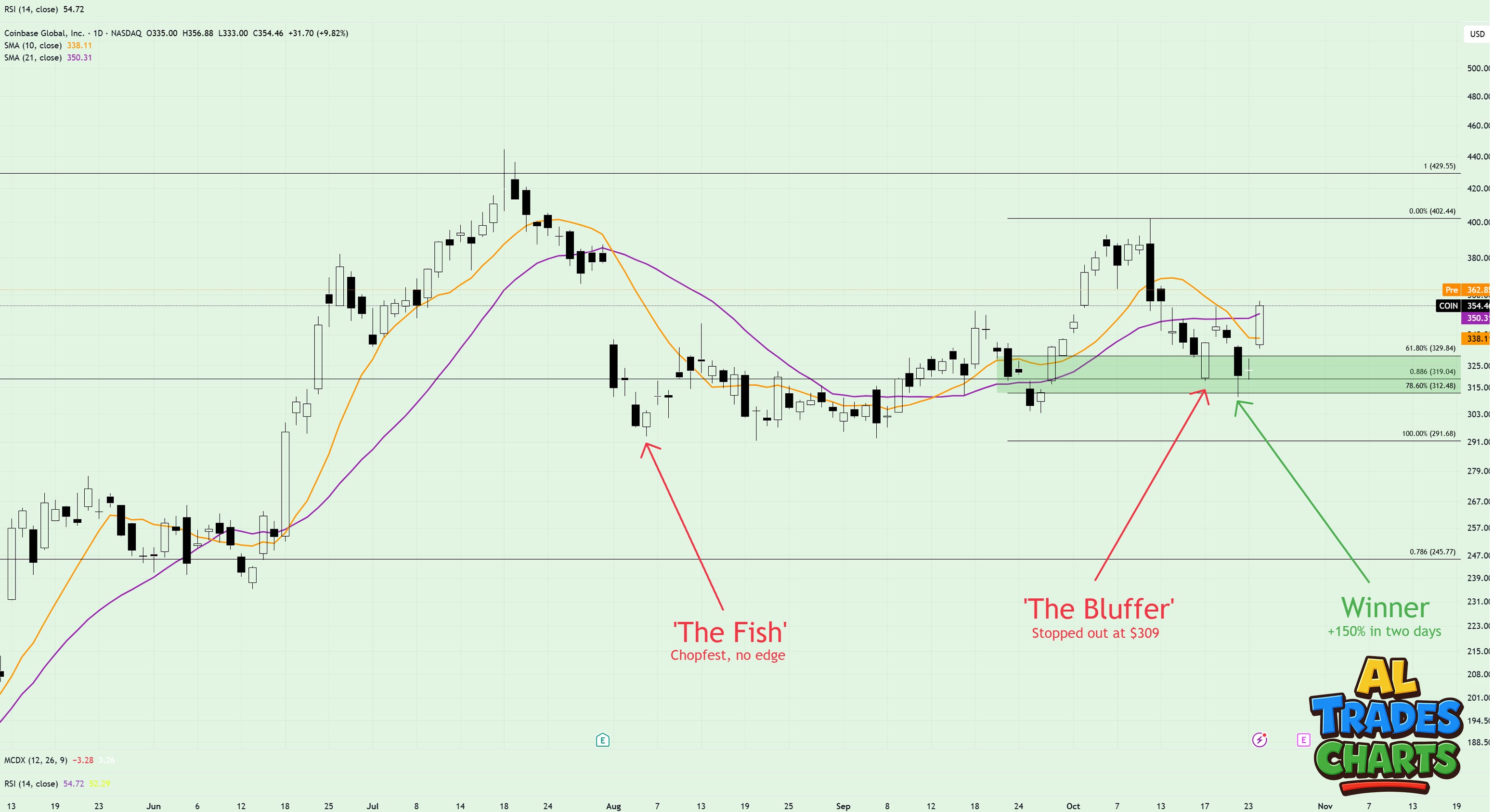
What I’ve seen play out on this ticker of the last few months is textbook poker play - and not in a good way. First came the buyers after the initial drop, only to see their position drop in value as Coinbase entered a multi-week period of chop.
Then came the buyers that first acknowledged the ‘golden pocket’ Coinbase was trading in following its recent pop and drop - only to see price retest fall beyond their entry at $325 before getting stopped out at $319.
And then lastly, those that waited entered the frame, scooping up calls at $319 before price burst higher, securing a short term trade that locked in over 100%.
Like I said, patience pays.
And Now, The Tricky Part
Of course, locking in a 100% win on COIN doesn’t mean the game’s over — earnings are this week, and I’m staring at the same familiar dilemma:
Do I hold into earnings, risking my gains for a shot at more?
Or do I close the trade early and bank what’s already a great result?
My biggest flaw as a trader has always been closing too soon. Letting winners ride is much harder than waiting for perfect entries — doing nothing is easy; doing the right something is not.
Still, if the strategy is to “add with size when the opportunity strikes,” then this might just be one of those times.
A Similar Story Elsewhere
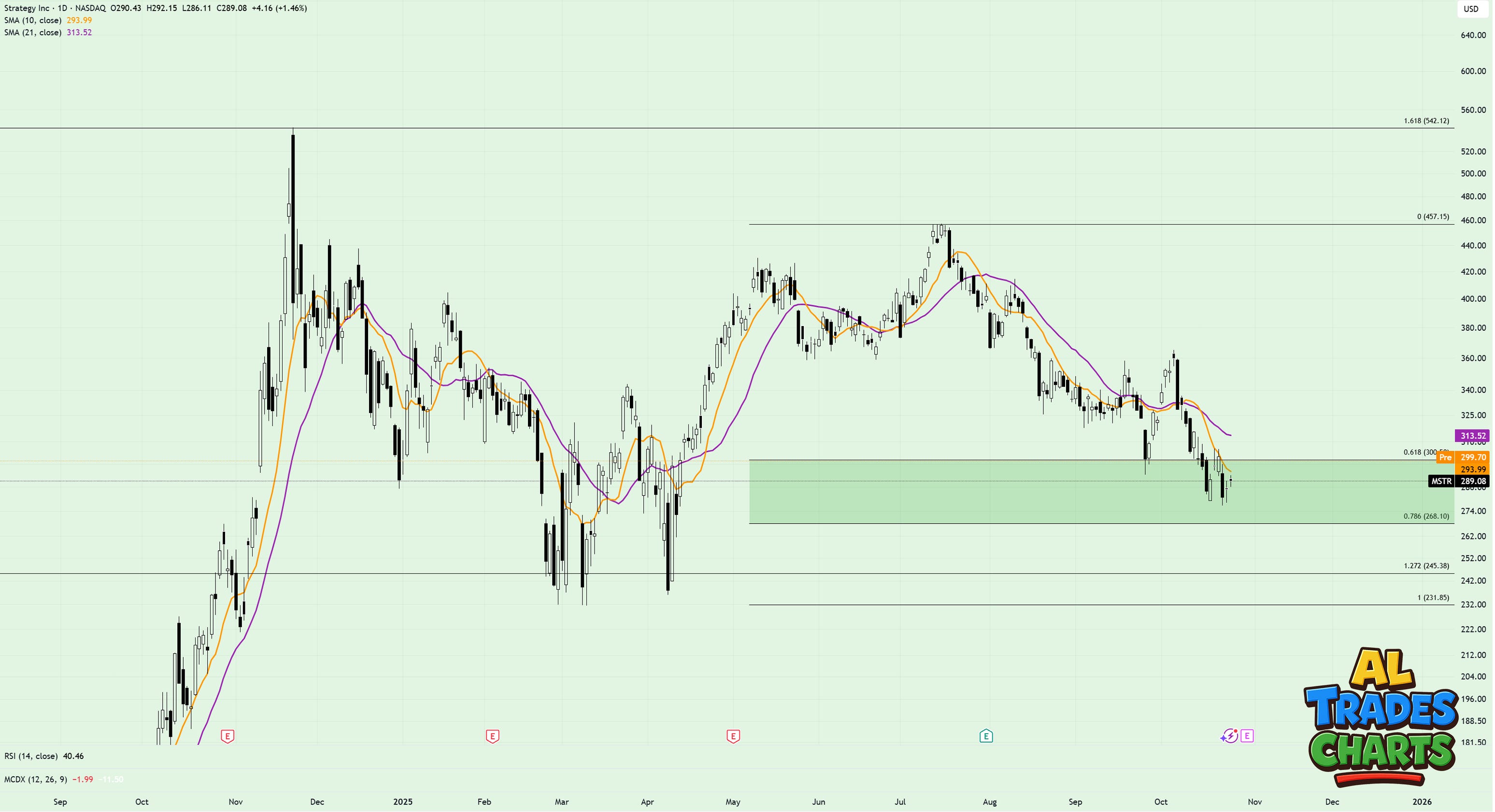
Look at MSTR. For weeks, the fish were yelling “buy the dip!” all the way down into the golden pocket. Then the bluffers jumped in — all now underwater or stopped out.
What’s left are the disciplined few — those who understand that if risk/reward stacks up and price holds the prior low, it’s worth a swing.
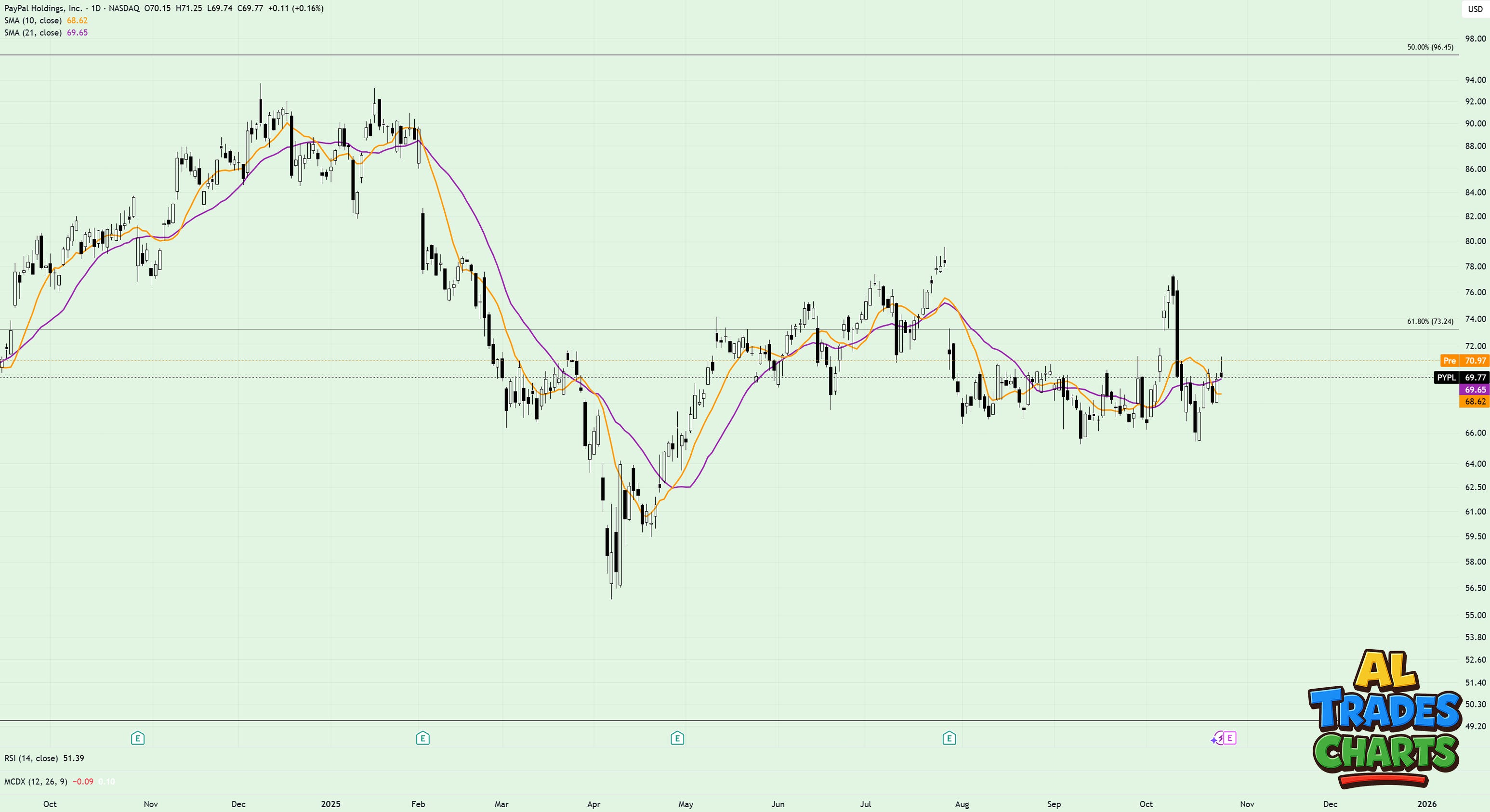
Same goes for PYPL: multi-week consolidation, a pop-and-drop, and now a clean setup. I’ve taken $80C expiring December for just over $2 — tight stop, solid structure, asymmetric upside. Let’s see what comes out in the flop.
Knowing When to Fold’um
So after a month of tight, conservative play, I’m finally back in a few hands — not out of boredom, but because the odds justify it.
While the fish and bluffers scramble to make up for lost time, I’m happy knowing my capital’s intact and my focus is sharp.
Sometimes winning isn’t about playing more hands.
It’s about playing the right ones.
And right now?
I’m at the table, cards in hand — and I like my odds.
If you enjoyed this post, please consider liking, reposting, or leaving a comment — it helps more than you think. Free to read, no Discords, no paywall — just markets, strategy, and the occasional poker table.