



Psilocybin is an interesting compound.
Best known as the hallucinogen found in magic mushrooms - an illegal drug across most of the developed world - most people associate it with the summer of love, music festivals and other hippy-adjacent activities.
What’s less known about psilocybin however, is that over the last twenty years or so, pioneering scientific research has shown that the compound has much more to offer society than a brief, hallucinogenic pause from reality.
While some studies have demonstrated psilocybin’s ability to produce rapid, significant and, in some cases, sustained reductions in symptoms of major depressive disorder when administered alongside psychological support (see Johns Hopkins 2020/21) - others have sought to prove psilocybin’s worth in combatting treatment-resistant depression, which is where Compass Pathways (CMPS) comes in.
The Basics
First things first, CMPS isn’t in the business of selling magic mushrooms.
The company is developing a pharmaceutical-grade version of synthetic psilocybin, known as COMP360, which is administered in tightly controlled clinical settings alongside trained therapists.
Every dose is measured, every patient is monitored and every trial is designed to answer one question: can this become an FDA-approved treatment for people suffering from treatment-resistant depression?
Note, this is an important distinction. Treatment-resistant depression isn’t someone having a bad week. These are patients who have often spent years cycling through antidepressants, changing dosages and trying different therapies, only to find that nothing sticks. For many, they’ve simply run out of options.
That’s the gap CMPS is trying to fill.
How Have Trials Progressed?
During its latest earnings report, management confirmed that COMP360 - the company’s cornerstone, synethic psilocybin based drug - met the primary endpoints in two separate Phase 3 trials, demonstrating not only a rapid improvement in depressive symptoms but benefits that lasted for at least six months.
If approved, that gives COMP360 a clinical profile unlike anything currently available for treatment-resistant depression and helps explain why many analysts believe it has genuine blockbuster potential.
Speaking of ‘approval’, the company has now begun the rolling submission of its New Drug Application (NDA) to the FDA, with the full submission expected to be completed in Q4 this year. Assuming everything remains on track, management continues to target a commercial launch during the first half of 2027.
Backing all of this is a cash balance of $433 million, enough to fund operations well beyond launch and into 2028, while the company simultaneously advances a late-stage PTSD programme.
The Elephant in the Room
Right now CMPS doesn’t generate any meaningful revenue and is largely funded by stock offerings and grants.
Unlike the likes of NVIDIA or Microsoft, this isn’t a business with billions of dollars flowing through the door every quarter. It’s a clinical-stage biotech, which means investors are effectively backing the company’s science, management team and ability to navigate the regulatory process. If FDA approval were delayed or, in the worst-case scenario, denied, the stock would almost certainly come under significant pressure.
That’s simply the nature of biotech investing. The potential rewards can be enormous, but so too are the risks. One day you’re up 50%, then next you’re nursing a loss. That’s just the way it goes.
The flip side, however, is equally compelling.
Should COMP360 receive FDA approval and launch commercially next year, CMPS would transition almost overnight from a company burning cash on research and development to one generating revenue from what could become the first widely available psilocybin-based treatment for treatment-resistant depression.
It’s the latter scenario that I’m betting on with a portfolio allocated of just over 5%.
Technical Analysis
Looking at the chart CMPS is in an interesting spot - having reclaimed its anchored VWAP from its 2020 IPO during the weekly session. For risk-averse investors, this offers a super tight stop below current levels.
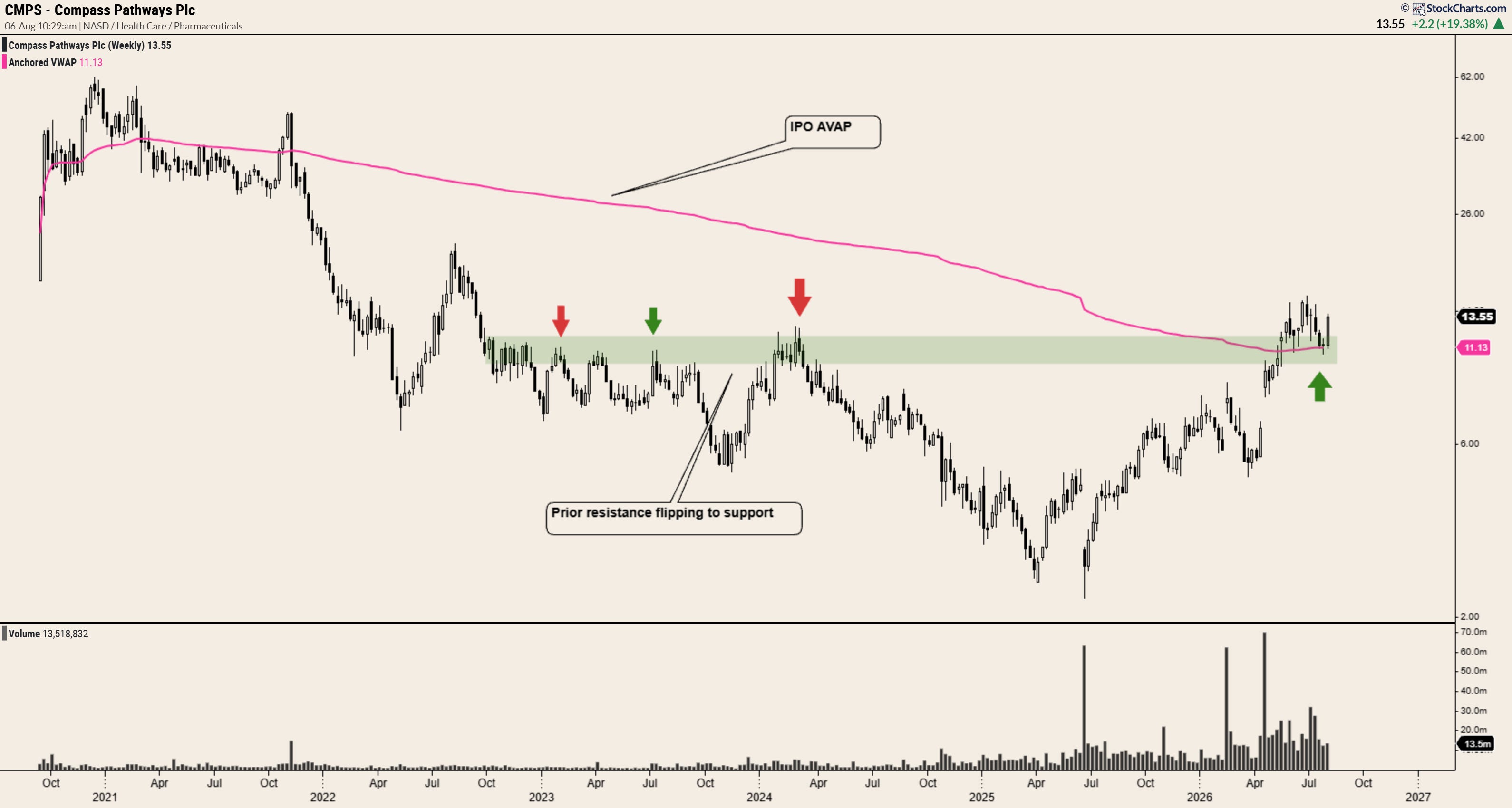
What’s more, volume has been supporting the uptrend that’s been in play dating back to mid-2025, with prior resistance now flipping to potential support.
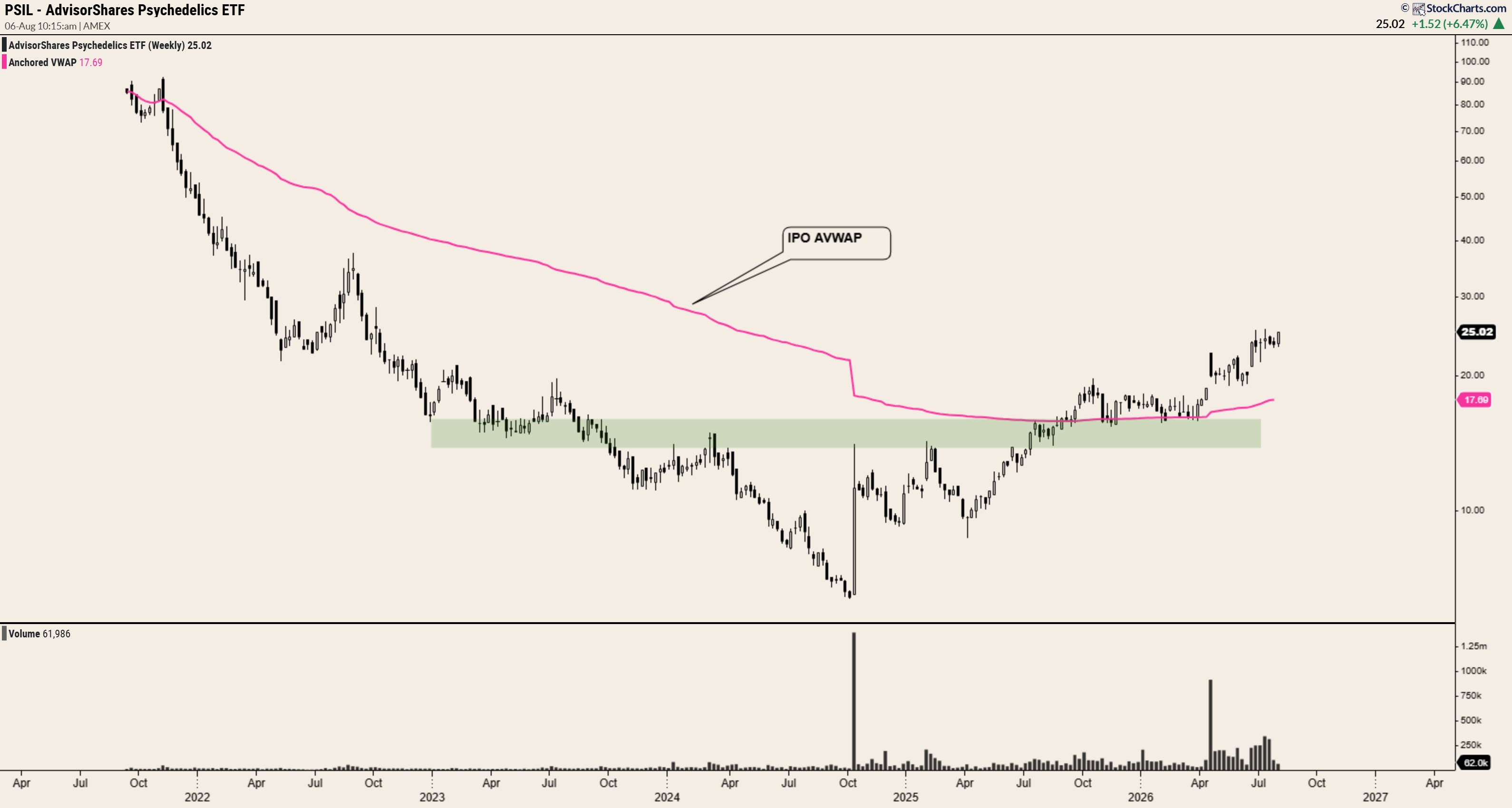
Supporting the trend is the broader psychedelic space, as evidenced by the PSIL chart below, which looks remarkably similar to CMPS - not entirely surprising given its 10% weighting in the ETF.
Further Reading
Where once psychedelics were seen as nothing more than a recreation drug offering users a momentary break from reality (and, more significantly, their egos), today we’re seeing everything from magic mushrooms, LSD and Ketamine re-emerging as therapeutic drugs used to combat depression, anxiety and other, complex mental health conditions - which makes them a compelling, and arguably ethical investment vehicle for those willing to roll the dice.
But don’t just take my word for it, please be sure to do your own research.
If you’re interested in exploring psychedelic space, I’d thoroughly recommend Professor David Nutt’s ‘Psychedelics’ as the best place to start. Other great options include ‘How to Change Your Mind’ by Michael Pollan and ‘Stealing Fire’ by Steven Kotler and Jamie Wheal.
Happy reading.
Best,
Alex
Disclaimer
The information contained in this article is provided for educational and informational purposes only and reflects my personal opinions at the time of writing. Nothing here should be interpreted as financial advice, a recommendation to buy or sell any security, or a guarantee of future performance.
Biotechnology investing is inherently speculative. Companies such as Compass Pathways remain pre-revenue and are subject to significant clinical, regulatory and commercial risks. While the potential upside may be substantial if COMP360 receives FDA approval and achieves commercial success, there is an equally real possibility of delays, setbacks or capital loss.
As always, do your own research, consider your own financial circumstances, and never invest money you cannot afford to lose. I may hold positions in securities mentioned throughout this article, and those positions may change without notice.
Very well done and saved me from doing some research. I don't ever do these types of stocks that depend on trials but the options chain is liquid enough on this one to where I don't have to worry about a 30% gap down. This one is interesting 👀