



It’s one of the most recited mantras on Wall St.
The trend is your friend, until it ends.
And yet despite the trend being so obvious throughout the summer months, traders have continued to fight it.
Tops were called in July, August and September based on seasonality myths, bond market jitters and shoddy data prints. Each time, stocks resolved higher.
To this day, signs of an imminent downturn remain muted. That’s just a fact.
XLP relative to XLY is making multi week lows
High beta is making new weekly highs
Risk assets - namely crypto - remain bid
And yet for the fist time in months I’m thinking of de-risking a little. Not because I’m outright bearish or fearful of a pending recession, but because there are a few things taking shape in the charts that I’m struggling to ignore - at least in the short term.
Psychological Patterns
When melt-ups like the one we’re experiencing occur, shifts in trading psychology become apparent.
Rotation into laggards starts to feel like a safe bet (note the pop in TSLA last week) whilst the riskiest of risk assets go vertical (BMNR, RIOT and various other crypto proxies).
The scramble to lock in trades on these assets can lead to furious gains, as anyone that bought TSLA at $340 or BMNR at $40 can confirm. But in my view, trading in such a way is anything but sustainable.
By ignoring warning signs, which only appear obvious in hindsight, the risk becomes skewed to the downside. Yes, breakouts can occur - and may continue to occur for some time - but when they’re built on euphoria rather than solid, technical levels, concerns of a market nearing its nadir become all the more difficult to ignore.
Technical Concerns
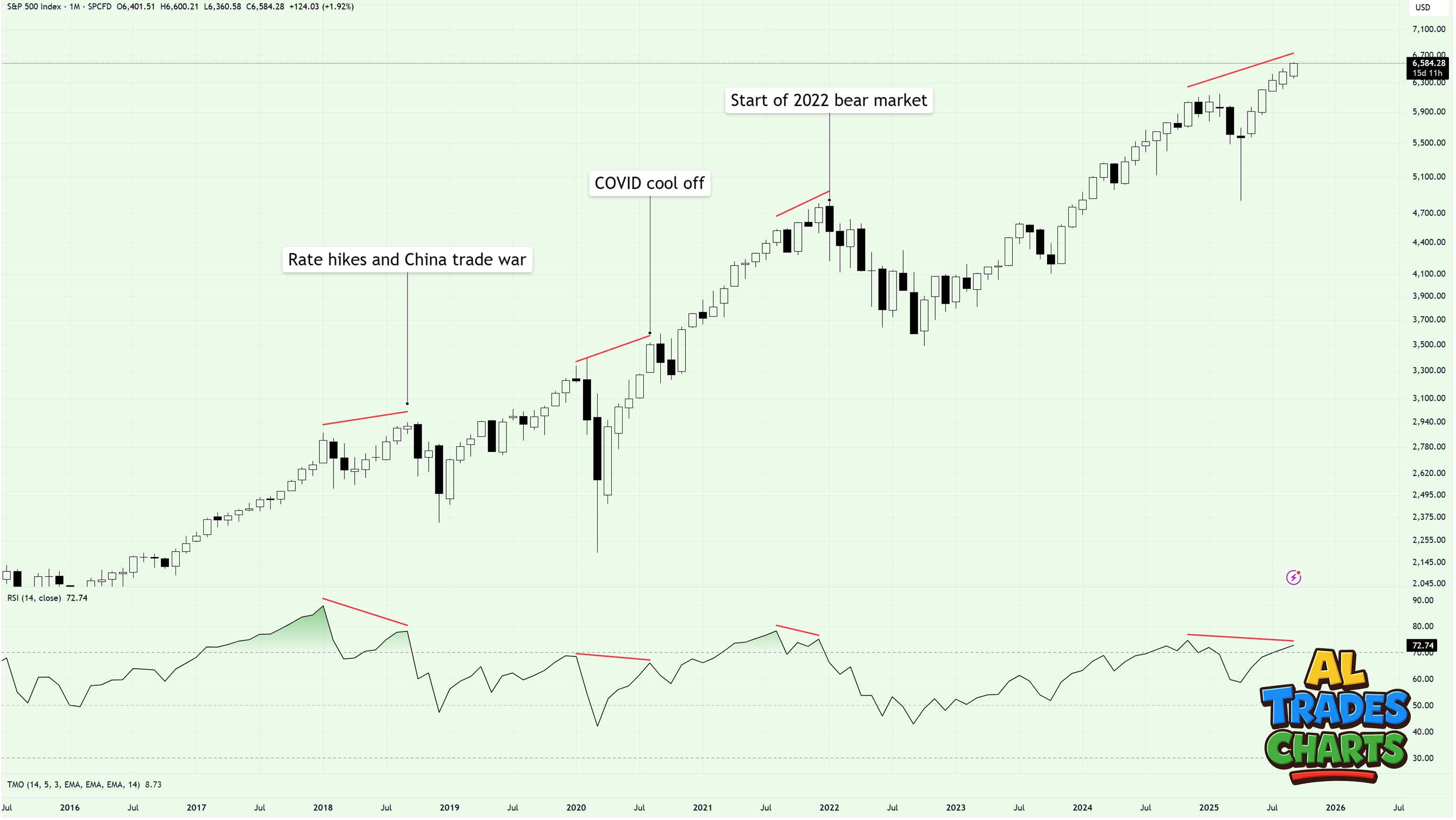
Exacerbating these fears is the potential RSI divergence on the monthly SPX timeframe.
As the chart suggests, such divergences have typically preceded notable sell offs:
2018: between September and December SPX dipped 20%
2020: between September and October SPX dipped 10%
2022: between January and October SPX dipped 27%
This time may yet prove different, with the divergence resolving higher — but if past is prologue, the warning signs shouldn’t be dismissed. Especially when we’re seeing these same divergences appearing on everything from Bitcoin to QQQ.
Liquidity Drying Up?
Every major blow-up — Bear Stearns, Lehman, SVB, Credit Suisse — shared the same trigger: repo dried up. Access to daily funding vanished, and the system cracked, no matter how “well capitalized” the balance sheet looked on paper.
Today, repo markets are flashing similar warning signs. Liquidity is tight, collateral is scarce, and money market funds — often miscast as “cash on the sidelines” — are already tied up as repo collateral. Far from being an extra buffer, they’re part of the plumbing that’s under strain
That’s also why a simple rate cut isn’t a cure.
Cuts don’t create reserves; they just shift money around. Without an active liquidity injection — from the Fed or the Treasury — repo stress can worsen, draining leverage and tightening financial conditions even further.
In short: when repo breathes easily, markets can dance. When it wheezes, the music stops. And right now, the system sounds short of breath.
The Shift in Macro Data
There are a number of reasons why Powell will cut interest rates this week, but the most important of these is the US labor market.
As noted in last week’s newsletter, revisions in jobs data wiped out 911,000 jobs in the latest BLS report. New claims continue to rise whilst JOLTS and NFPs continue to fall. In short, the labor market is weakening, and for a market fueled - in the most part - by consumer spending, these data prints are an obvious concern.
Inflation also remains elevated - fueling stagflationary fears. But right now, it’s the labor market that concerns me the most. Keep a watchful eye on the dot plot and Powell’s tone following this week’s FOMC - a hawkish cut would likely spook the markets and trigger a sell off. My strategy is to straddle SPY and QQQ heading into the FOMC - but you do you.
Theories Are Just That, Theories
Despite the concerns highlighted in this post, it’s important to note that until the charts suggest we’re nearing a top, the trend remains our friend. Buying calls have been the winning strategy over the last few months and may continue to be for a little while longer.
But with FOMC on the horizon, markets looking stretched and sentiment nearing extreme levels, I’m happy banking some winnings and sitting tight.
It may sounds boring, but that’s where I’m at heading into this week.
If the markets continue to pop without me, so be it. But if a shake-out does occur and we see equities, crypto and risk assets fall, I’ll be ready for the next leg of the journey.
Best,
Alex